

















Customer Delight & Building BITSOM: Udai's Journey in Hospitality & Education
- Copy

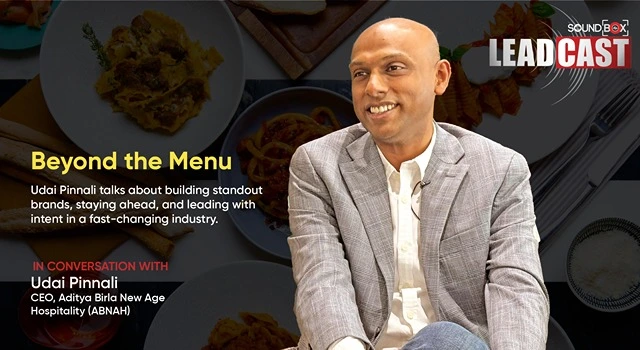
Introduction & ABNAH's Secret to Engagement
Brian: Given the expanse and rapid growth that you dwelt upon, that this industry sees, I mean, what has been your secret sauce, so to speak, I mean, to keeping it engaging for different cohorts? I mean, because there are very vast and different cohorts. I mean, there are so many options available now. What do you feel ABNAH experiences offer that is kind of unique? I know you dwelt on it a little earlier. Yeah. But I'd like you to deep dive just a wee bit more.
Udai:Sure.
No, you're absolutely right. I think a part of the answer is that, that, you know, you'd want people to feel warm and welcome and so on. You know, we are also the same consumer, but a different segment at different points in time depend on the occasion. The same person who goes and has a very experiential, expensive meal, goes and probably stops their Mercedes on the side of the road and has a cutting chai when they're feeling like you go to Starbucks and probably have this coffee. So it's the same consumer who's behaving a little differently at every point in time. So cohorts are also within a single individual, while there are cohorts at different price points as well.
So there are these two different ways in which we approach at ABNAH, the entire journey for us of building brands and formats, not just brands within a format, but multiple formats. And one thing we certainly do when we're doing any of this is go and hit the field ourselves. Over the last, let's say, 12 to 18 months, all of us, including me and the teams, not just from one function, chefs, marketing teams, strategy teams, we've between us, and this is a true number, have met upwards of a thousand consumers.
Brian:Wow.
Udai: Yeah.
ABNAH’s Purpose Statement: “Customer Delight”
Udai:And this is very important to us because then you really understand that, you know, you're not building something for your own creativity and your own fancy sakes because there's some trending food or fashion going around.
But this is what consumers want, really. What are they really asking for? That is how you find out what the gaps are in this so-called overcrowded market, where there seems to be no space.
You'd be surprised how much space there is if you really go and talk to consumers, what they want, but are consuming because what's being given to them instead of what they really want.
Brian:You know, you dwelt a little bit earlier on purpose, and that is so important. Now, taking cue from that, you know, how does Abner's purpose statement marry the unique experience that you offer people?
Udai:You know, that's a very interesting question, and it's a very important one because, you know, it all starts at the home, right? In that sense, it all starts with our teams in the office, and there's a lot of diversity in the teams.
We have people who are absolutely creative, the chefs and so on and so forth who come from hospitality, but there's also this part of people from hospitality who are very disciplined and process-driven, which is the front of house, the general managers, and so on.
And then there's the marketing teams who need to use numbers and yet need to be creative, and then there's strategy and finance teams who are a lot more about numbers, numbers, and numbers because it's about ensuring that the bread comes onto the plate, so to speak.
What binds all of them together is that purpose, and there's this thing that we try and ask when anyone joins, whichever function, or we're doing an induction, that what's your role, what's your job? I think it's a journey, as I said, and it's a long journey. It's not an easy one, but we would have reached a certain milestone when anyone who's in the ecosystem of Abner says, My job is customer delight.
That's it.
How Purpose Unifies Diverse Teams
It doesn't matter whether you're clearing bills for vendors or whether you're literally standing on the floor. It's customer delight.
What are you doing towards it?
And that purpose statement out there is what binds everyone together. And to the precise question that you had of how does it build uniquenesses, that it is this feeling that you want to give to these consumers when they walk in that any Abner space they walk into, if they're able to feel, as I said, that warmth, that welcoming service, because one might ask that how does it matter if I'm sitting in supply chain or I'm sitting in accounts?
Well, you do your job on time. You get the best ingredients. You ensure that your bills are cleared. There's a happy vendor supplier somewhere who's going to help you in difficult times. who's going to give you the best of produce, who's going to give you the best of output. It's all connected.
I think that is where for us the purpose really plays out and again, I wouldn't want to get ahead of myself and say we're 100% there, but people are getting it. That's the journey that we want to be on. Right.
Deep Dive Into Supersan: Mumbai’s Japanese Spot
Brian: I'm going to kind of deep dive into one of the areas or one of the chains, you know, with the launch of our new business, Supersan.
Oh, yes. How is it different from other Japanese spots in Mumbai? And there are a fair few.
How are we different?
Udai: You're asking me that. You haven't been to Supersan.
Brian: I haven't yet.
Udai: You haven't been to Supersan. You wouldn't have asked me that question otherwise.
Guilty as charged.
The Izakaya Concept & Experiential Design
You know, now I'm wondering, you know, I told you we'll go to Ode now, whether we should go to Supersan after this.
So, right. So, you know,
So, you know, Supersan is a delight for me, Brian, because it's really completely the team's dream come true. There's some very good Japanese places out there which all of us like and really love to go back to time and again in the city. But then we looked around.
We said that, again, as I said, where's the gap in the so-called overcrowded market, even within the cuisine? We said that a place that doesn't really exist is a very relaxed Japanese place. It's not about tatami mats. It's not about white tablecloth.
It's not about being able to really do your research going in there. We modeled it after a typical Izakaya. You know, the kind that we would like to believe is, you know, Japan is dotted with people, the kind of place where people go to after work, impromptu, loosen their tie, sit down with their colleagues, have a couple of drinks, a few more laughs, some quick grub, some grub before you just leave for the day and go back home.
Probably you can come back on the weekend with your family for lunch or brunch, but it's a very relaxed space. And that, we believe, is the distinctiveness. We built a great bar program.
We have a very young and very sharp mixologist. She actually runs her own ready-to-drink spirits and, you know, beverages. And it's just this, on the other end of the space, there's a bar and the other end is a collab that we've done with the comic store where there's a rack full of manga T-shirts and figurines and sneakers and so on.
It's a very experiential, young space. And that's how we built it. And slightly connecting to the earlier question of where does this uniqueness come vis-a-vis other brands or even within our own brands? It's about this.
It's about the teams thinking through for the consumer, talking to them, understanding that what's the experiences they're missing? What can we bring together in a space that has not been there together earlier? So there's great chuhais and sakes and so on, on one end of the restaurant. On the other end, you have great T-shirts and manga and chawanmushi and sushi happening. Just a relaxed, lovely space.
Adapting Offerings to Cultural Contexts (Mumbai vs Delhi)
Brian: So you marry it to the larger kind of vibration, you know, beyond food. That's prompting me to another question. How do you adapt offerings for different cultural contexts while maintaining brand integrity?
Uday:
It's not about price, it's not about cost. Whether it's a person who's giving you 20 bucks for a cup of tea or whether they're paying 20,000 rupees for a bottle of wine. It's about value.
They need to feel that they've got what they've paid for, whether it's an experience or whether it's a product. And we realized this. So we started off and continue to be right now largely a Mumbai.
Our presence is largely in Mumbai. Now we are moving into Delhi and CR as well very soon by the end of the year and so on and so forth. And then the same rigmarole, you know, then we hit Delhi.
We went on weekends. We went on weekdays. We went to different kinds of outlets.
We're seeing what does Delhi feel like? What does it sound like? What does it eat like? Do you realize that everything else being same, they just like larger portion sizes on the table, right? They just want to ensure that the table is well loaded and the entire set of people feels very taken care of. And Mumbai is relatively a little more fancier. They're okay with three dimsums in a basket.
Delhi may not be. Now that's a small cultural nuance. But these are the things that you pick up when you actually go and hit the markets.
So the same Yavacha while maintaining the same authenticity of flavors and the finesse on the food may look a little different when you go to Delhi to suit what they are going out for. What's the occasion they like to celebrate? They like music that's probably a little louder, etc, etc. So those are the small tweaks you do while keeping your core safe.
You know, so I think that's the important part.
Future Expansion: Beyond Mumbai & Delhi
Brian: Super insights. And you've spoken about Mumbai, next stop Delhi.
I'm going to push the envelope just a little bit. I mean, do you see beyond Delhi other emerging kind of opportunities, other regions that look particularly promising, so to speak, for ABNAH?
Udai: Yeah, sure. So, you know, the three largest markets in the country continue to be Mumbai, Delhi and Bangalore.
And they're not just large by size, but the proportion of people who are far more exposed and are ready for new experiences is here. So Bangalore, for sure. But very interestingly, in the last couple of years, Brian, other markets are quickly emerging.
Hyderabad, Pune. You know, these markets are continuing to see a larger number of people who are also going up that curve of evolution and want to experience great brands. The number of people I bump into say they've flown down from Hyderabad for just to go to Yavacha and they wanted to experience it.
Brian: Oh, man.
Udai: Yeah, yes, yes. So, well, there are great experiences in relatively smaller cities like Jaipur, etc.
You know, where these niche restaurants, which are amazing, are popping up. So the market is opening up and it's a journey again, I would say. And there's the economics of it, of course.
You need the cohort to be large enough for you to be able to go and invest there. But I think it's a matter of journey. And as you know, I mean, in ABG, once we get in, we are playing for the long term.
We're not looking for 5 years or 10 years. We're going to be there for a long while, forever to come. So not in a hurry, but we're definitely going to go deep.
Most Adventurous Project: Building BITSOM During Lockdown
Brian:I'm tempted to ask this question, Uday, especially you being you. I mean, what has been your most, if I can call it, adventurous or unconventional project to date?
Udai:Glad that you asked that, in fact. You know, this one's not about a business role, but it's about building an institution.
BITS Pilani is an absolute institution. It's a legendary institution. It's been around for 75 odd years.
And, you know, when Mr. Birla was thinking of expanding it and growing it, it already had some 15,000, 16,000 students on its campus. They were all engineering students. And we said that, you know, we don't want to be another factory that's churning out only more engineering students.
We said, what do we do? And we went to the drawing board and we did a lot of research, went down to students, tried to understand the space and so on. And then we realized that there are a few spaces that's available. And then we said, OK, you know what? I think what we're probably lacking is a very contemporary business school that can add to the scene of students being able to.
You know, one of the statistics was that if you just take the top one and a half, two percentile of CAT exam takers, that number comes to some ridiculous 10,000, 12,000 students, whereas the number of seats in the top B schools at the time, the really good ones, was only about 3,000. So just look at the amount of capability and talent that was there in the country. But they would then choose to go probably outside of India and so on.
But why was it adventurous? It was very unique, though. I mean, building a B school is not something that you do every day. And you and you always have these armchair discussions coming from your own experiences of being in a business school yourself that, you know, I wish this were there, that were there and the other were there.
Now, here was an opportunity to build one with all of those ingredients, so to speak. And finally, when the approvals came in, it was February 2020. In one month, we hit lockdown.
Through lockdown, we built BITSOM. We didn't stop for a single day. We took permissions to go out and scout for sites.
We went to different parts of Mumbai. We went to Kalyan, where the current campus is. We went on tons of calls to onboard all the professors from universities abroad.
We worked so seamlessly with a very good consultant. We were working with the core team. You know, the school was ready for the admissions in 2021.
And we put together the construction actually happened. Fit outs actually happened at the site through COVID. And we met a lot of these people for the first time after having worked with them for six months.
After, you know, almost when the school was ready and, you know, it was it was no less than an adventure that, you know, you are at a point in time trying to hire students for ABG or, you know, you are a student. But here I was pitching to recruiters to recruit from BITSOM. It was it was all of this really culminated when the first convocation happened and a parent walked across and said, you know, you and she said to me, you know, my daughter today, she has a job.
She always dreamed of. It was such a great school. Thank you.
It still gives me goosebumps and moves me because that is what you live for. And this is what you create for ABG, right? I mean, this is the legacy that you work for. You and Mr. Birla and I, if I may quote him, you know, we were just talking about it and he said, Udaipur Tantra Tech is the largest business you are monitoring for me.
And we said yes. But for both of us, I mean, this project was beyond any business that one could have probably built. Wow.
It's impact.
Advice for Emerging Hospitality Leaders: "People First"
Brian:Yeah, no, sure is. Man, you've got me thinking and thinking hard.
I'm going to go back to the food and beverage business or Abner's business. I mean, given the fact that you've done the road in various aspects of business, you know, is there a bit of advice that you have for emerging leaders in the hospitality industry? I know it's a stereotypical question, but I must throw it at you. You know, leaders or potential leaders who aspire to innovate, to make, you know, or leave a meaningful impact.
I mean, what's your bit of advice to them?
Udai:Yeah, you know, it's beyond a stretch, Brian, for me to, you know, it's really it'll be audacious for me to believe I can advise any leader, forget hospitality leaders. What I tell myself, though, when I examine how can I be a better hospitality leader? And what I look for when we are hiring senior leaders is something that I can tell you. It's about our people first.
It's about it's about how you approach your own teams, how you mentor them, how you coach them and how you align them to the purpose and the vision that the company has. You treat them the way you want them to treat your guests. I think a lot of it gets sorted.
It's really about ensuring that your people are well taken care of. And that's a mantra that we would like to live by and keep repeating till the cows come home. It's very important to us.
Well, there are many other small nuances because it's a very tough business. It's a very intricate business, so to speak. The only other thing I would like to keep on top of all our minds, and this is for anyone in hospitality, is kind of back to your first question, almost about grammable food and so on and so forth.
Create Memories, Not Just Instagrammable Moments
People come back to not these memories that are on your feed, but memories here. People record things here.
This might pop up a year later on your memories and someone might say this is where you went. But when you're thinking and sitting and saying, OK, where do I go this evening? What pops up is the memory that's here. Create experiences and food that's creating memories and is craveable.
I think that's the mantrathat we would like to live by. And if anyone is misguided enough to ask me for advice, that's what I would say.
Brian:You know, I must indulge myself and say I connect and feel you big time.
It's something that grabs me all the time. You know, creating meaningful, impactful experiences for people prompted me to get into the experiential field. Yeah, yeah.
Host’s Reflection & Farewell
Udai:You've been a brilliant voice, both literally and metaphorically for the business. And, you know, we really admire what you've done. Thank you so much.
Brian:That's a mutual sentiment. I want to again thank you for taking time out, for hanging with us. Importantly, for sharing your vibe, sharing your thoughts and want to wish you all the very best.
Thank you. And thanks again. Thank you so much.
We can use all the wishes we can get. Thank you so much for thinking it's worth spending time here with me at ABNAH and it's always our pleasure. We love to be great hosts.
Udai:Thank you. Thank you. Cheers to you.
OK, what an incredible conversation with Sir Uday. I was chatting with Uday and I said, I want to keep it casual. And he goes, no, no, please call me Sir.
He was kidding. Yes. This is why I love the man so much beyond his professional achievements.
But yeah, what an incredible conversation with Uday. And thank you guys for joining us on Leadcast. It's extremely important to us what we do at Leadcast.
And given that as the backdrop, we'd really like for you in the comments box below to put thoughts down. Let us know how we can up the game at what we do. Yeah.
And we promise to provide a lot more interesting episodes like the one just gone by. Thanks again.
Watch full video on YouTube - Customer Delight & Building BITSOM: Udai's Journey in Hospitality & Education