

















From Kurkure to Couture with Satyaki Ghosh
- Copy

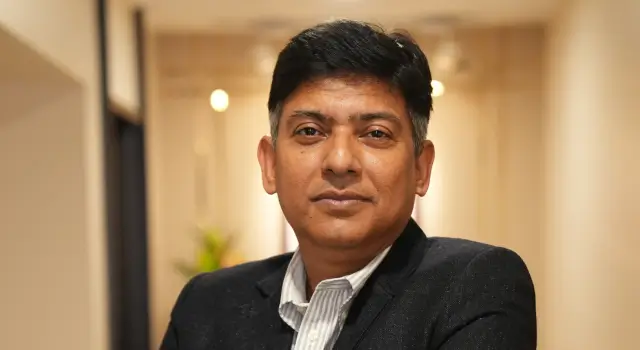
In this episode, Satyaki Ghosh, CEO – Cellulosic Fashion Yarn at Grasim Industries, shares his journey from leading FMCG icons like Kurkure to pioneering sustainable textiles at the Aditya Birla Group. He explores the transformative potential of circular fashion and rental models in luxury and lifestyle, while stressing that Gen Z and Gen Alpha are highly informed, ambitious, and must be nurtured by leaders with intent and vision. Ghosh also underscores that work-life balance is not a myth—it demands discipline, planning, and daily practice.
00:00 – Career journey & accessible luxury fashion
Satyaki Ghosh: Maybe you can't buy a Gucci bag or a Prada dress but today you can rent it for 2 days and maybe that comes in your budget. If it was up to me, if I was God, I would stop it and I would have more sustainable product because it's good for the earth over a period of time.
Brian: Well hello and welcome to another episode of Leadcast part of the group's Soundbox initiative. I mean today we're joined by Satyaki Ghosh, a dynamic leader with over 27 years of expertise spanning FMCG retail and industrial business.
As the CEO of the cellulosic fashion yarn business at Aditya Birla Group, Satyaki brings a wealth of experience from industry giants like L’Oreal, General Electric, PepsiCo and Spencer’s Retail.
Previously as CEO domestic textiles, he spearheaded breakthroughs including the launch of Koala Studios, a pioneering initiative embracing the wealth‑out‑of‑waste kind of concept from shaping brands to driving innovation. His journey truly is nothing short of inspiring. Thank you so much Satyaki for joining us. It truly is a privilege chatting with you and I … and I’m sure everyone else who’s watching is so looking forward to hearing your thoughts and reactions.
Now Satyaki, you’ve gone from launching fiery Lays flavours to perfecting skincare formulations and now of course to pioneering sustainable fashion yarns. I mean, is there a method to this madness or do you just keep, you know, it to keep life interesting? What drives you?
Satyaki Ghosh: So every time I changed a job I changed an assignment. I wanted to do more and learn more about general management. But along the way, what has happened in all these industries is that I’ve learned about new products, I’ve learned about new industries and frankly life has remained interesting. So all in all I think it has fallen in place.
Brian: I love that line about life has remained interesting. I think it has a lot to do with your mindset as well. But we’ll talk about that.
02:21 – Winning in Gujarat market with PepsiCo
Brian: Now PepsiCo’s Ring of Honor is their highest accolade. What’s the story behind that win of yours, precious win? And where do you keep the trophy?
Satyaki Ghosh: So I’ll answer where I keep the trophy — I keep it at home.
Brian: You do? Okay.
Satyaki Ghosh: But the story behind is… is a proud moment for me and my that‑time team. I came into the organization as a Regional Manager West for Lays based out of Mumbai. Now the interesting piece of fact is my hiring manager was Samik Basu who’s now the Hindalco CHRO, so he can corroborate this.
When I joined West it was the laggard region and generally in FMCG business West is either the biggest or the second‑largest region. You know East and South are always smaller. It’s between North and West because the consumption is higher here. But West was the smallest and there were a lot of issues.
04:24 – Innovative sales strategies in retail
Satyaki Ghosh: One of the biggest issues was that in salty snacks one big competitor in Gujarat was Balaji Chips. Now Balaji gave value for money: for ₹10 they gave 75 grams, and Lays gave 40 grams at that point in time. And the Gujarati mindset was VFM meant Balaji. So our market share in Gujarat, when the all‑India market share was close to 40% in salty snacks, Gujarat market share was 2%. So it was a very tough market to go in because nobody wanted to keep Lays.
That market I think we conquered and we got from 2% to 18%, which took the all‑India share from 40% to 45–46% because Gujarat was such a big market and we were just not being able to penetrate.
That was a big win because for the last five to ten years we were not being able to crack the Gujarat market. And we did another thing in Mumbai and Delhi: the business had these large racks in Green Park etc. outside the stores where Lays would be stored and Lays in effect became modern trade before modern trade came in because in a kirana store you could touch and feel the chips. So the optics went up.
06:24 – Recycling & circular fashion with Regel
Satyaki Ghosh: But in small shops you couldn’t put those big racks because the BMC would pick them up with the stock and the loss was the company’s, because no shopkeeper partakes in losses. So we created these small what we call “Trimurti racks” for the khokas in Bombay panwalas—they close at night and when they open they open like this. So we put them on here, not on the footpath, but still visible. The optics were high, our service frequency had to go up, and we executed that to perfection.
Because of these two changes, our sales went through the roof and West became the fastest growing region—and that was the reason I got the Ring of Honor.
Brian: What’s one innovation in sustainable textiles that excites you the most?
Satyaki Ghosh: I think this recycling of polyester has come a long way. We don’t deal in polyester—polyester is our competitor—but polyester has done really well.
Now recycling is happening in many parts within ABG. We have a fashion and textile testing hub called TRDC in Karachi. They are working with many of our textile companies. For example, they work with Domestic Textiles on recycled linen; with our CSY business on recycling our waste; and with the Viscose business to recycle theirs.
08:25 – Fast fashion vs. sustainable trends
Satyaki Ghosh: We are trying to create products by recycling used industry waste and also some post‑consumer waste. How to get it back, make it back into fiber and regenerate products so that you don’t throw away and it doesn’t end up in landfills. That’s one.
There’s also a business called Thai Acrylic Fibre which I ran for three years. They developed a product called Re‑gel made from regenerated waste fibers that’s 50% waste and 50% fresh—and it sells at a premium over the regular product. That is a great example of textile regeneration and circularity.
Brian: You’ve said true sustainability is about doing good for yourself without harming others. If you could make one sustainability rule that the fashion industry had to follow, what would it be?
Satyaki Ghosh: Reuse is the big piece coming up. In our childhood days, our mothers did it. A fairy‑wala would come with a scale, trade old clothes for utensils or something in exchange. Those clothes would go to the next town and people would use them. In India it was always there—but now it’s more fashionable. In the West and Nordic or European countries, high‑street reuse shops are full—beautiful, laundered clothes used two or three times—and people buy them.
10:27 – Work-life balance through discipline
Satyaki Ghosh: Reuse is now fashion, and it builds circularity in the industry. It just helps.
Brian: We know you’re not a fan of fast fashion. As someone who has seen the industry evolve firsthand, what’s your take on its future?
Satyaki Ghosh: Fast fashion—I may not like it, it’s on my wish‑list that it should not exist—but it will remain because the middle class is growing. But the real middle class in India doesn’t have that much spending power.
Fast fashion is here to stay—also because the next generation doesn’t want to wear the same thing twice. You can’t wear a ₹10,000–₹12,000 dress twice, so you buy many good‑looking cheaper products.
12:36 – Gen Z’s entrepreneurial spirit
Satyaki Ghosh: The economy also runs on demand and supply—so maybe fast fashion does something for the economy. So it’s not going away.
Reuse and rental models are emerging—so maybe you can’t buy a Gucci bag, but you can rent it for two days. You go to a party in a Prada dress, Dolce & Gabbana sunglasses, and a Gucci handbag—all rented. It’s good because merchandise costs a lot. Internet startups and VCs are backing it, and Bombay fashion circuit already has a few.
Brian: What’s your secret to work‑life balance? We spoke briefly about it earlier—can the rest of us borrow some of that discipline?
Satyaki Ghosh: Discipline. I build my holiday plan well in advance so my boss and team know when I’m not there. I also build a holiday calendar for my immediate team so we’re never all out together.
14:36 – Family-first decisions and joining ABG
Satyaki Ghosh: For example, I had a short holiday in April finalised in February, and a 10‑day break in June finalised in March. Tickets booked, leave applied and signed off. Team knows when I'm going off. That needs discipline and planning—but also you don't carry over your leaves. You take them and plan well, which gives you work‑life balance.
On weekdays, during work hours, gossip less, do meetings on time. I start meetings on time. Manage your day so you go home and have time for exercise or whatever you like.
Watch full video on Youtube: Leadcast – From Kurkure to Couture | Satyaki Ghosh | Part 1