

















Mastering Temperament & Navigating Markets: Bala’s 30+ Years of Investment Wisdom
- Copy

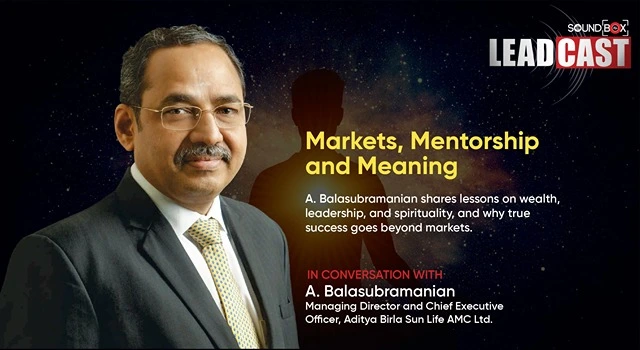
(00:00) – Introduction to Bala & Leadcast
Brian: Well, he has seen markets rise, fall and reinvent themselves. But through it all, he has stayed steady — stayed rooted in wisdom, led of course by conviction. This is Leadcast, where leadership meets life.
Bala:Markets teach you passions, but more than that, they teach you perspective. Early in my career, I thought success meant mastering numbers. Over time, I've learned it's really about mastering temperament. Finance may be a number game, but leadership is about trust, clarity and staying curious.
Brian:Hi Bala, how are you?
Bala: Hi Brian, good to see you. I'm fine, doing alright.
Brian:Thank you for inviting me to your office, to this beautiful cabin.
Brian: My pleasure, as always.
(01:03) – Bala Unplugged: Food & Music
Brian: You know, it's always a privilege chatting with you and before we deep dive into the markets and the stuff we're going to chat about, I just want to do a bit of Bala Unplugged. Are you okay with that?
Bala: I'm fine.
Brian: Okay — what's your go-to comfort meal after a long day?
Bala: Of course, I prefer South Indian meal.
Brian: But give us some details.
Bala: And end up with curd rice.
Brian: Oh, okay. You are also a music lover. I believe you are learning music and I know you are a music lover from back in the day. So what's your playlist for a volatile working day?
Bala: I play — of course listen to the music, definitely it's one.
Brian:But what kind of music?
Bala: Mostly Carnatic music. But I am also learning, singing the Lord's name, which is called Nama Sangeetham . So there is also something in singing the name of the Lord — it gives you that much inner better feeling. Since I'm learning, I'm also actually just keeping humming with great understanding. It gives you some sense of deviation from your normal thinking process.
(02:14) – Advice for Young Investors
Brian:That's incredible. I'm going to go slightly closer to your professional personality now. One thing that you believe young investors overlook?
Bala: So, overlooking investing for long term versus short term gain. Most people think making money is easy looking at short-term gain. But I always believe short-term gain is temporary. If you want to retain your gain for long term, then you must give long time period for the investment to perform.
Brian: Three to five years?
Bala: Three to five years. Second is, people think speculating you can make money — they'll start thinking everybody is making money, making money is easy. But my own experience: money making is tough unless you stay on course for long.
(03:15) – Earliest Money Memory
Brian: So we'll get into our chat now. It's been fun — the volley of questions and fun answers — but now let's settle into conversation. Bala, let's roll back the years. What was your earliest memory of money? Has that moment shaped your approach to wealth creation today?
Bala: Yeah, definitely yes. First of all, thanks Brian for having me part of your discussion — a privilege. See, life of course gives a lot of lessons. As an investor in the capital market, the early lessons I got when I was age 22-23 — where you always fiddle with the market thinking you will create huge wealth with high expectations and very short return expectations — doubling or tripling money in one or two years.
When you have such high expectations inevitably you meet with failures. When I started learning and getting into the capital market, the first few expectations versus outcome were miserable. Because you are a little deep in money, you become further greedy and therefore you don't book your profit — you don't sell. You keep your expectations high.
That's where I learned the first lesson: what goes up can come down . And there will be failure — but still, if you keep long-term vision, I think you can create wealth.
(04:40) – Learning Cycle & Passion
Brian:What goes down can come up as well.
Bala: Can come up as well. So that's when I joined here in '94, since then we have seen crisis. In each crisis your learning curve only gets better. As an individual, you also learn from mistakes, market volatility — and that shapes your investment thesis.
Brian: You mentioned 1994 — that makes it 30+ years. What has kept you inspired? What has kept you committed to the mutual fund industry all these years?
Bala: So it is about passion towards your business. Mutual fund — I always believe — it's a service to the investors. Creating wealth comes next.
First you are putting a platform. You are getting deeply involved in managing the money. In this process you learn, and this shapes your investment style. As an individual, you continue to learn. The market, I always believe, is a great leveler. Market teaches you. You don't need to go to any classroom to improve your learning curve. (6:01) The market teaches you. So, that keeps you actually growing all the time. You have to come back with a great amount of commitment. So, be at it, stay at it, and continue to learn, and continue to be passionate about building this business, and deep involvement.
I always believe, one of the firm beliefs that I have, platform is provided to you. It is only a question of how do you use the platform. So, I used to believe Aditya Birla group is a platform, good brand platform. You have been given the responsibility to use the platform to build the business. The platform should be utilized for bringing your individual contribution to the maximum extent possible. I mean there is no right answer to that, but as far as best effort that you can put. That's why I think it kept me going. The learning curve when I talked about, learning curve come from market, learning curve come from your bosses, learning curve come from the way the founders looks at your business and then makes you stay in the business for long, make you think long term, and so on and so forth. There are many such things also got involved in the whole process.
I am very sure we need more than just a quick chat. We are having to really learn from you some of the nuances. If I can, I am sure there were moments that were uppers, there were moments that were downers, and all of them high on learning.
(07:29) – Defining Moment: 2009 Crisis
Brian: Can you share a defining moment in your career that tested you?
Bala: Of course I can quote many, but I’ll take one — the 2009 global financial crisis. All of us being finance professionals, being in the mutual fund industry — you feel the impact directly. Market falls are directly correlated to you; market rises are directly correlated to you.
There was uncertainty — whether the world financial market will remain strong, whether the industry will survive, whether the firm you work for will manage the crisis. During that time I also got offers from outside — but I felt I should not leave the organization in a bad time.
(08:57) – The Power of Brand
Bala: One thing that helped us is representation of the brand. I used to go to the market — meet institutions — borrow from banking industry, sell assets. When you carry the brand, the door opens faster. After that, it's up to you to strike the deal.
Brand impact comes during crisis. As a manager, you have to use it to your advantage.
We used to run pillar to post looking for solutions. It took 35-40 days. September to November — Lehman collapse. During that time, you have to stay on course, take proactive steps, handle customers, and protect brand image.
Reputation is very important. I must admit — we had to knock the door of Mr. Birla as well. He made one phone call — that was enough to manage the situation.
(11:14) – Spirituality & Leadership Style
Brian: You’re spiritually inclined — how has spirituality influenced your leadership?
Bala: Spirituality has come from childhood. I used to go to Patasala to learn basics of Vedas — after school, 6-7 PM. It's all mug up and recite. Reciting mantras became part of extracurricular activities — not ritual. Parents also prayed — so association grew.
Spirituality gives calmness. It keeps you grounded. Life is not that easy, but also not that tough — you play it as it comes.
(12:46) – Work-Life Integration
Brian: People speak of work-life balance, but you speak about work-life integration. What does that mean to you?
Bala: I don't differentiate work and life — both go hand in hand. Whether personal or professional — for me it remains the same. Invariably you end up giving 80% of your time for work and 20% for life — ratio differs per person.
Personally, I used to have a seven-day working policy — so work-life balance becomes out of track. I never thought about differentiating.
(13:57) – Staying Calm Through Market Cycles
Brian: You’ve seen multiple cycles — booms, crashes, recovery. How do you remain calm?
Bala: One thing I'm a firm believer of: often we discuss managing risk — but managing risk comes next. Being agile — agility — is more important. Tracking happenings that impact sentiment and portfolios.
During uncertain times, you cannot keep quiet and you cannot keep worrying. Both are wrong. If you keep worrying, you never find a solution.
We deal with public money. Market is an unknown animal. Sometimes we try to find solutions for unknown stuff — nobody can answer. So during such times — play it as it comes.
(15:47) – Rituals, Energy & Discipline
Brian: Is there a ritual you follow?
Bala: One — I believe in punctuality. Morning 6–6:30 max — the moment sunlight comes, day starts. Second — I do my rituals, chanting Gayatri.
Sometimes I enjoy making breakfast. Then I come to the office with a clear schedule. This habit came from bond trading — market forces you to be at your desk. I used to even open the office.
Whether rain or flood — I would go. I also believe in keeping a light heart. If your energy level goes down, everything becomes difficult.
(18:30) – Mentoring: Ask vs. Tell
Brian: How do you mentor next-generation leaders?
Bala: Earlier my style was instruct and tell. Later I learned ask vs. tell — thanks to the Harvard AMP program. It gives clarity on empowerment vs. execution.
You must differentiate between what the team must do and what only you can do. Not everything done is right and not everything done is wrong — sometimes situation forces the outcome.
I always give benefit of doubt to the batsman.
Mentoring is continuous — not only when they need you, but when the team needs you. I follow open-door policy. Whether 11 PM or early morning — they have liberty to call.
Even today as MD & CEO — I pick the phone on the second or third ring.
(21:41) – If Not Investments…
Brian: If you weren't in investments — what would Bala be doing?
Bala:I am deeply connected to my roots. I believe in giving back to my birthplace — agriculture and village background. I still run agriculture activities — not for profit, but to provide opportunity for people to work on their land.
Second — I get involved in service activities. If they need support for events or institutions — I help.
(23:29) – Closing
Brian: My day has 24 hours. How many does yours have — 36? 48?
Bala: 24 hours only — within 24 hours you have to crunch everything.
Brian:Bala, it's been an absolute pleasure. One sit-down is not enough. Thank you for taking time to share all these gems.
Bala:My pleasure. It's always nice interacting with you. I'm glad we could do it today — thank you so much.
Brian:Thank you for tuning in and soaking it in. Let us know your thoughts in the comments below.
Watch full video on YouTube - Mastering Temperament & Navigating Markets: Bala's 30+ Years of Investment Wisdom