

















Udai: Building India's Most Inspired Hospitality | Nonlinear Growth & Culinary Excellence
- Copy

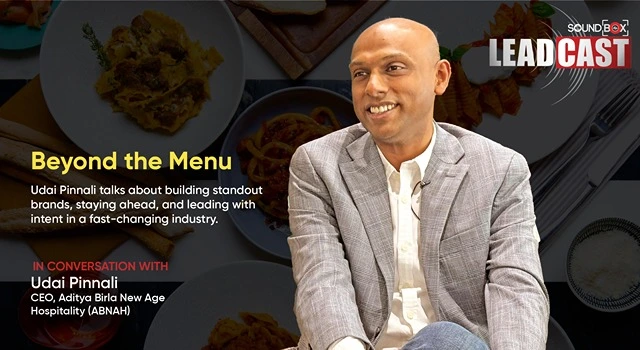
0:00 — Introduction to Udai & Leadcast
Brian: From the boardroom to the kitchen pass, he's building India's most inspired hospitality experiences. This is Leadcast, where leadership meets life.
Udai: People sometimes ask me what was the turning point. For me, it was learning that growth doesn't always look like a promotion or a title. Sometimes it's about launching a new business or an institution. Sometimes it's not saying yes to the easy path or the obvious one. And now it's this — building brands that make people feel something deeper, help them make memories.
0:19 — Udai's Definition of Growth: Beyond Promotions
Udai: Good morning, Brian.
Brian: Hey, good morning. How are you doing?
Udai: I'm well, thank you. How are you?
Brian:How are you doing?
Udai: I'm very, very well. How's your day been going?
Brian: A little hectic, but lovely to see you. Thank you for joining us at Leadcast, man. Much appreciated.
Udai: My pleasure. My pleasure, absolutely.
0:46 — Greetings & Rapid Fire Question
Brian: Okay, so suggestion — before we get serious, let's get curious.
Udai: Okay, let’s do that.
Brian: Great. So Udai, one quick rapid-fire question for lack of another way to say it.
Udai: Sure.
Brian: So if you were to pick one restaurant from ABNAH for a meeting, which one would that be?
1:11 — Favorite Restaurant for a Meeting: Oud
Udai: I'd say most definitely Oud. Yeah, I think it's a lovely space — great ambience, lovely food. And you can interact with people very casually, yet with a lot of intimacy. I think it's a great space to be.
Brian: Oh, nice.
Udai: Yeah.
Brian: Okay, that meeting should be with me.
Udai: Oh, we can go right after this.
1:39 — Udai's Grounding Ritual: Kipling's "If—"
Brian: Great. What's that one ritual over there that keeps you kind of grounded?
Udai: It's Kipling’s If—.For the last 20 years, I've had a copy of that wherever I've been, within my eyesight — just going through those lines: "Meet with Triumph and Disaster and treat those two impostors just the same." Very, very grounding.
Brian: Oh man, Udai — always, but always a pleasure chatting with you.
Udai: Same here.
2:05 — Udai's 17+ Years with Aditya Birla Group & Nonlinear Growth
Brian: More than 16 years with the Aditya Birla Group, and you have served as the Executive Assistant to Mr. Kumar Mangalam Birla. You have led the launch of a new business school — none less than BITSOM — and are now leading the way at ABNA's whole project… I mean, the Chief Executive Officer.
Brian: What has growth looked like to you?
Udai: Nonlinear. You know, to put it — I think growth, Brian, I would say is what one perceives growth to be. And I must say that it's not always felt like growth. You know, you're doing stuff and there's a lot of learning that's happening — and the curve's not always very straight.
There's this thing Adam Grant says in Hidden Potential, it's a fantastic book — that the line of growth, which is usually shown like this on a graph, is very misleading. Sometimes growth looks all topsy-turvy and so on.
And you know, sometimes you take a side step to get a very different kind of experience. Sometimes you step back to learn something very new. And sometimes you just leap — in a way you've never envisaged that you will — into something.
4:20 — Evolution of F&B: Immersive, Shareable Experiences
Udai: …and then I started — and by the way we're not counting here — but 17 plus years.
Brian: Oh, okay.
Udai: Yeah.
Brian: Okay. I stand corrected. Happily, I must add.
Udai: So, you know, I was in the telecom business. I was not in the HO, I was in Hyderabad. I was in service delivery — not in one of the swankier functions like marketing, sales, or whatever it’s perceived to be.
And I was in prepaid — a very mass segment and so on. I never realized I had a structured path. I thought: Where will I get to?
But then I think growth, really for me then, is about picking what you're doing, really thoroughly enjoying it, and doing a great job of it — and then you get where you get to.
Brian: Interesting perspective you provide. So I'm going to move to the F&B business — more F&B businesses are now trying to curate immersive, visually striking, shareable experiences… nostalgic dishes and Instagrammer favourites. What's your take on this — if I can call it — evolution in the industry?
Udai: See, I think like a lot of categories that evolve with consumers, consumers are much better exposed now. They're more affluent, they're more aspirational, etc. Food has now become not just about sustenance — it's about self-expression. Food is fashion. People use food to make a statement. People want food to reflect who they are and so on and so forth. So as the cliché goes — people first eat with the phone, with their eyes, and then they consume food. And they want people to know where they were, what they were eating, and so on.
6:04 — ABNAH's Focus on Culinary Excellence
Udai:So I think it's part of a lifestyle. It's growth.
But I just think that we are what we do when no one’s watching us, you know, in a way.
Brian: Well said.
Udiai:And a lot of times I think while one might share where they were and so on and so forth — I would think of it like this: the last time you went to a place you really wanted to and loved to go back to — you had people you really like and you were having food you really crave.
Did you dive in for your phone? Probably not.
So the share of eyeballs, I don’t think, is necessarily equal to the wallet share of the consumer — where they would like to go and spend a lot of time, spend a lot of their money and attention, and have great craveable food.
And in that sense, we at ABNAH have always been very, very culinary-excellence-forward, so to speak. Can the food be 'grammable? Should it look great? Of course it can. But for us, it’s about making a great honest plate of food that one would like to come back to again and again and again. And if you can make it look very photogenic — yeah, it’s a bonus. So I think — well, to each their own — it's not just about nostalgic and great-looking food, but it’s about people coming back to food that they love and really crave.
6:43 — Heritage & History in Food: A Deep Dive
Brian: Okay, interesting. Now there’s been more chatter — should I say — on the play of heritage, of history, when it comes to food.
How do you see that playing with our curated menus?
Udai:Yeah, I think that's a great segue — because it’s in line with what I was saying earlier — that people are very well-travelled now. They’re far more aware. There’s a lot more information out there, right?
And while at a point in time the country and the people wanted everything to be very relatable to their original palate, so to speak — people are now ready to try and push themselves to have authentic food.
8:03 — The Story of Varsa Restaurant
And India — while we talk of it as a monolith — I think as we all know, it's a misnomer. It's 50 different countries.
And for me, going away from my cold palate is not just about having Korean or Italian — it's about trying really authentic food from, let's say, Lucknow, Awadhi — which probably I've never really known. Because what a lot of people have been exposed to is Punjabi and Mughlai.
So — you know — it’s stuff like that.
And hence now: rootedness. How connected the food is — matters a lot to people.
I'll just take a quick example because we have this restaurant called Varsa — it's based in NCPA.
And that food has its own heritage, its own history. It’s the Persians who travelled to India. And then — they thought Delhi was too busy — they bypassed the outer ring road and went straight to Lucknow, right?
And they settled there. And it was a great blend of what they brought and what they conceived there.
And Wajid Ali Shah was asked by the British — given a pension — and sent to Calcutta.
you know, where he said, Allah-e-Butto mujhe koi dikhaye Lucknow aur mere sohne me bhi mere aata hai aah Lucknow. He was really paining for Lucknow because he was he was a Nawab there. He was sent out and then there was no gosht. There was not enough meat, but the Portuguese had brought potatoes there. They replaced the meat with potatoes and made a different kind of biryani.
So that food evolved from Persia to Lucknow to Calcutta. And then they got a daughter married to the Nizams of Hyderabad — and as was the custom — they sent maids and cooks with her. And then the food travelled from Calcutta to Hyderabad — and then it evolved further.
It's the journey of food. And that's what we discovered and that's what we are making at Varsa.
So people like these stories. People like that history behind it and trying different cuisines. I think it matters a lot.
9:50 — What Excites Udai About Building Hospitality Brands
Brian: Man, your knowledge — and the fact that you've obviously deep-dived into this — is incredible.
Udai:No, we really like to enjoy what we're doing, you know — and get into the heart of it.
So as I said earlier — this is growth. Right? I mean you're learning something new every day. You're doing something exciting. You're a different person.
I mean — that's growth.
Brian: That's coming through loud and clear, Udai.
10:10 — India’s F&B Industry: Size & Opportunity
Brian: Now — you mentioned from Varsa to Jolie’s toSupasan — ABNAH is creating, I think, some of India’s distinct culinary spaces, which is brilliant. What excites you most about building hospitality brands?
Udai:Yeah, sure. See — food is a very core consumer category. And it's something that’s been there obviously since the birth of time until now.
But the way it's evolving is very exciting.
Some estimates say it's a 65–70 billion dollar industry in India. It's one of the largest. And it also employs one of the largest workforces in the country.
And with aspiration increasing, as I was saying earlier — a lot of people are now opting to look for great experiences, a lot of organized brands and so on.
And despite all this, and despite all the growth happening — you realize that there are probably four or five companies today which are more than a billion dollars in valuation — and then there’s a long tail.
By some estimates — the way Singapore eats out: about 50+ times a month (what you eat out — including deliveries, two–four times a day — 50% of that comes from outside). The U.S. or Europe is about 30. China is 20.
For India, it's about 8 or 9.
That’s the headroom that's there.
For Mumbai or Delhi — probably people eat out about 15 times a month including deliveries.
So just the opportunity to be able to go out and participate in one of the largest consumer businesses for the A ditya Birla Group — is a great opportunity.
And when you are given the opportunity to participate in that kind of growth and build something of that order — it's obviously very exciting.
And I think that’s a very important part.
12:02 — ABNAH's Purpose: Enriching Lives Through Food
I have a but. You know — it's out there on the wall, and we should go up and take a look at it in the office once.
And it's very important to us — our purpose:
"To enrich lives through the power of food and the magic of shared experiences."
It's that purpose that really excites us a lot more. Because think about it: for the most part, experiential dining — at whatever price point — it's not because you can't cook at home or you don’t have a meal. There's so much happening outside — at your work, generally in life, and so on. When people walk into a restaurant — they want to leave all of that outside practically. They just want to have a great time with their loved ones, people they like — or sometimes maybe just by themselves with a cup of coffee. It's a privilege for us to be able to participate in that with them and give them that break they need. And it's a tough industry — thin margins, heavy competition, hawkish regulations, whatnot. But when you see a guest smiling — happy — walking out at the end of the meal — all of that’s sorted. And then you're not thinking of the industry size and how tough it is to run the restaurant and so on. That fulfilment — I think that's really exciting — to be able to participate in that entire story.
13:12 — What Udai Wants Guests to Experience at ABNA
Brian: You almost answered — or should I say half-answered — my next question. Always ahead of the game, you are. You know — what is it that excites you about food? And I’ll qualify that: what do you want people to experience and discover when they explore ABNA palates?
Udai: So you know — it's not as much about ABNA palates alone. We wouldn't like to get ahead of ourselves and think that we are this very large player and one should view us very distinctively or separatel.
We're very much with the industry. It's a growing space. And in that scheme of things — we want our guests to come in and to feel welcomed. To not feel intimidated. We are into authentic cuisines — as I said. You know: we do authentic Italian, we do authentic Japanese, we do authentic Cantonese, we do authentic Awadhi. We like to believe that we are doing honest food. At the same time — we ideally don't want them to look at a menu card and feel intimidated and hesitant to read something out and ask something. Yet — we don't want to water down their experience. That balance is what is a little tricky — but not impossible. That's where your staff and your service comes in — whether they make you feel welcome, make you feel comfortable, are able to explain the menu to you without sounding condescending — yet not being snobbish at the same time. That is very critical for us — and that's what we would like to create. But let me caveat this with saying: we’re not there yet. It's a journey. And I'm happy to confess that. We’re getting there. But we're confident that we’ll get there — because we are very clear about the intent.
15:09 — Udai's Top 3–4 Menu Recommendations
Brian: That’s a confident — but really honest take. And more power to you, Udai. What are the top three to four — if I might ask — things to order across restaurants, across spots? I'm putting you on the spot, I know.
Udai: You're putting me in a corner — against my chefs who create menus which are 20–30 dishes long. Nevertheless. Yeah, sure. I think, you know — if you go to Oud as we were speaking about earlier — I would like you to try the Nobu’s Tarboos or the Muskmelon. These are great mocktails — so flavourful — you won’t miss any spirits even if there are none in it. Come to Supasan — I think while you can order all your sashimis and nigiris and so on — you should definitely try the Chawanmushi. It's like a warm hug to your soul — it's such a nice warm egg-custard dish. If you go to Yauatcha — you should definitely order the Cheung Fun — vegetarian for me — but if you're a prawns person, certainly you can do that. I can go on and on. But since we're on it — if you go to Varsa — you should try the Panch Patta Saag with the Magasnaan. People think that Awadhi food is all about non-vegetarian — but it’s not true. Chef Mukhtar’s mother-in-law is a consummate cook of non-vegetarian food — but she’s a vegetarian herself. And there’s such amazing vegetarian food out there in Lucknowi cuisine. I think you should definitely try Varsa. Man — you’ve got me salivating, so to speak. That’s the idea — show me the money. It sure is, and it’s working.
16:53 — Sourcing Ingredients: Local, Sustainable & Authentic
Brian: When it comes to sourcing ingredients locally — and yet sustainably — keeping it true to the cuisine — how do you strike the balance, if you do?
Udai: Okay. So I think this is in the realm of saying that — of course, if I need authentic ingredients for some of these cuisines which are not Indian — we have to obviously import some stuff. But how do you yet balance it with being local and so on? See, I think it's again an interesting question. I'll take a couple of examples. We work very closely with the founders of Narathai in Bangkok — and they have an expat chef who comes down at a regular frequency, works with us — we take them out to the market. In the Northeast — nowadays — the Seven Sisters have great vegetables and herbs growing which are very close to the flavour palette of what grows toward that part of the world — as a continuum. So we try and identify ingredients which give you the same flavour profile without compromising on the authenticity.
Why do Cantonese chefs pick prawns from the East Coast of India?
Chef Rahul picks up his cheese from Himachal — and some great vegetables from hydroponics farms near Pune — yet does great European food. So we don't necessarily see this as conflicting goals for sourcing. It's a little bit of hard work to also ensure your costs are under control while you're doing all of this. I think — but it's doable. I think you just have to ask the question: who made those rules? You just have to go out and explore.
18:27 — Conclusion & Farewell
Watch full video on YouTube - Udai: Building India's Most Inspired Hospitality | Nonlinear Growth & Culinary Excellence