














Nylon’s Second Spin
- Copy

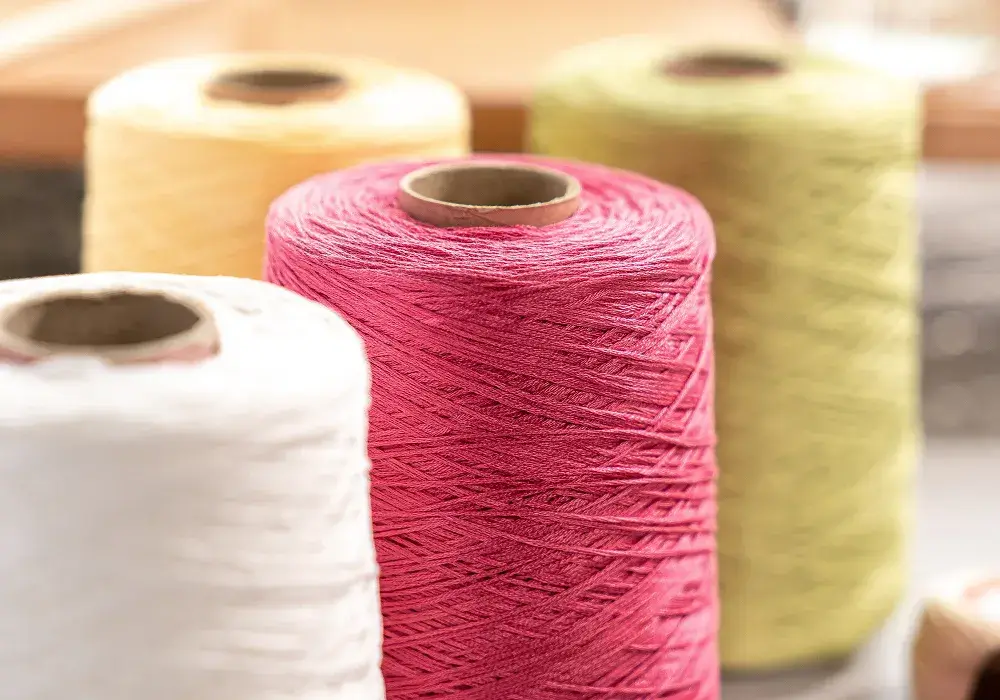
Walk into any sporting goods store, run your hand along a rack of activewear, or pull on a pair of seamless innerwear, and there is a reasonable chance that nylon is doing the work. It is one of those materials that earns its place quietly. Strong enough for outdoor gear, soft enough for skin contact, resilient through repeated washes, vivid enough to hold the deepest dye. For over half a century, it has been one of the textile industry's most reliable workhorses.
And yet, nylon has a problem that the industry could not solve for the longest time. It is derived from petrochemicals, and for most of its history, once it became waste, it stayed that way. Offcuts from spinning facilities, trimmings from fabric production, rejected bobbins from texturising lines, all of these accumulated with limited pathways back into productive use. The industry could manufacture nylon at scale, but it had not figured out how to close the loop.
That gap is where Nuenyl begins. Developed by Century Enka, part of Aditya Birla Group, it is India's first 100% chemically recycled nylon yarn, and the first of its kind to be manufactured at scale in the country.
The problem with starting from scratch
Sustainability in textiles has often been framed as a materials substitution story. Replace this fibre with that one. Use less of this, more of that. It is a useful frame up to a point, but it tends to sidestep a more fundamental question: What happens to the material that already exists?
During industrial nylon manufacturing, waste is generated at multiple stages of production across spinning, winding, texturising and fabric processing. Traditionally, this pre-consumer waste had few good options. Some was downcycled into lower-value applications. Much of it ended up in landfills. The machinery existed to make nylon at enormous scale. The machinery to recover it reliably, at industrial volumes, was another problem entirely. One that chemical recycling technology has only recently made tractable.
Chemical recycling works at the molecular level. Pre-consumer nylon waste is broken down to recover caprolactam, the fundamental building block of nylon polymer. That caprolactam is then repolymerised and spun into yarn again. The process essentially rebuilds the material from its foundations, which is why the resulting fibre can match virgin nylon in softness, strength, moisture absorption and colour retention. Not approximate it. Match it.
This is the process at the heart of Nuenyl.
Nuenyl at a glance:
- 100% chemically recycled nylon yarn
- Made from pre-consumer industrial waste
- Certified: GRS, OEKO-TEX Standard 100, REACH compliant
- Available as Draw Textured Yarns, Air Textured Yarns, Flat Yarns, Solution-dyed Yarns, and Recycled Nylon Chips
What scale actually requires
It is one thing to demonstrate that chemical recycling of nylon is technically possible. Research institutions and startups have shown that for years. It is another thing to do it reliably, at commercially meaningful volumes, with the consistency that global textile supply chains require.
That distinction matters more than it is sometimes given credit for. A garment manufacturer sourcing fabric for a major retail customer cannot absorb variability. Lead times, denier specifications, colour response, tensile behaviour, all must perform within tight tolerances, batch after batch. Sustainability credentials are increasingly important to procurement decisions, but they do not override the fundamentals of the product.
Century Enka's position here is built over three decades of experience in nylon yarn manufacturing combined with in-house control of every stage in the production process from recycling to spinning. That integration is not incidental. It is what makes it possible to offer competitive pricing, faster lead times, and the kind of flexibility on custom specifications that manufacturers need when making sourcing decisions.
A shift that is already underway
The textile industry is not waiting for a single breakthrough to rearrange itself. The change is slower and less dramatic with a gradual shift in what procurement teams prioritise, what brands are willing to put on a label, and what consumers are starting to demand. Traceability is becoming a baseline expectation rather than a differentiator. Questions of where a material comes from and what happens to it afterwards are moving from the margins of sourcing conversations to the centre.
Nuenyl is designed for exactly this moment. Not as a niche offering for brands that want to make a sustainability statement, but as a material that can be adopted at the scale at which the textile industry actually operates.
For Aditya Birla Group, whose manufacturing presence spans industries and continents, Nuenyl’s launch is consistent with how the Group has approached industrial transition earlier as well. That means gauging the convergence of technological readiness, supply chain development and market demand, and building the infrastructure to address it.
The loop, in other words, can be closed. It just takes the right combination of technology, infrastructure and manufacturing depth to do it at scale. Century Enka has built that combination. Nuenyl is the result.